

By Garrett Byrd
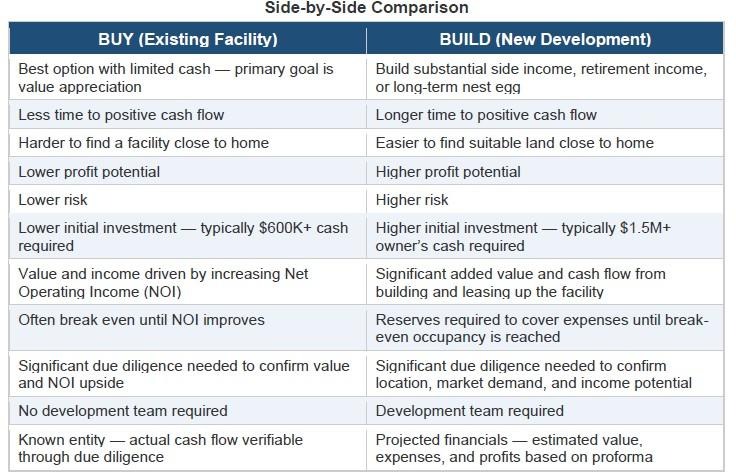
Buy versus build gets treated like a personality quiz. Are you patient. Do you like risk. None of it decides anything. Three things do: how much cash you can lock up for three years, how long you can go without a distribution, and whether your spread survives being half wrong on your assumptions.
The number that decides it
On a ground-up deal, one number matters before you sign the land contract: stabilized yield on cost against the cap rate the asset will trade at. In 2026, Class B suburban cap rates are running at 6.0% to 7.0%, Class A climate 5.0% to 6.0%, tertiary drive-up 7.0% and up. Build into a 6.5% exit and you need a yield on cost north of 8%. That spread is the entire reason to accept construction risk, carry the project, and three plus years of your life.
Run it honestly and most deals die here, which is why under-construction inventory has fallen to roughly 3% of existing stock. What still pencils has one of three things: land basis below market, conversion math at 40% to 60% of ground-up cost, or a supply-constrained submarket where you can command $1.70+ per sq ft. Without one of those, you are not a developer. You are a donor.
On an acquisition, use the going-in cap on trailing twelve months of collected revenue. Not asking rents, not gross potential, not a proforma line called upside. Collected. Every dollar of NOI you add after that is worth about $15 at a 6.5 cap. You are buying the right to fix somebody’s neglect and get paid fifteen times for it.
The rent roll is a story, not a fact
I have never seen a rent roll from an independent seller survive contact with the bank statements. Anyone can edit a software report; no deposits, no income.
The seller says 88% occupied. Strip out concessions, anyone 30 days delinquent, the units holding the sellers family’s own furniture, the free one the manager’s cousin has had since 2019, and you are at 71%. Value the deal off that. Anyone past 60 days is a lien sale, not a tenant. Ask when the last auction ran; if they don’t do auctions, you found units dead for two years and a lien statute you are about to learn the expensive way.
Rate history is the thesis. Rates frozen since 2021 while the operator down the road gets $120 for a 10×10 and this one gets $85. That gap is your return. Phase increases at $10 to $15 every few months and model the churn on the first two letters. Ancillary sits on the counter and most independents capture none: 300 units at $12 tenant protection, 60% adoption, is $26,000 a year at near-pure margin, or $400,000 of value at a 6.5 cap.
Then the capex the previous owner forgot. Get on the roof, cycle every door, watch where water runs after a hard rain. Pavement kills more deals than anything: sealing is cheap, replacing two acres of asphalt is six figures no lender funds. Order the Phase I. Pull the zoning letter, because a grandfathered use may not survive a fire.
Building means buying time
Ground-up storage is not a construction project. It is an entitlement project with a building at the end. Three to six months of permitting, six to nine months for a certificate of occupancy on drive-up, nine to fourteen on climate, then 24 to 36 months of lease-up. Three to four years to stabilization with interest accruing the whole way.
Hard costs before land and soft: $55 to $85 per gross foot for single-story conventional, $80 to $120 for single-story climate, $105 to $170 for multi-story climate. Add 25% to 40% for land, soft costs, and FF&E. Steel is still moving on tariffs, and data center work is pulling MEP labor out of the Sun Belt, so your bids will beat your feasibility study. Utility extension is the sleeper: forty thousand on a clean site, ten times that if the jurisdiction wants a turn lane.
Two numbers people fake. Absorption: three to four percent of net rentable square feet per month is healthy; a study assuming eight means you hired a bad consultant, not found a good market. Reserves: carry plus opex until breakeven, which sits at 50% to 60% economic occupancy, around month 14 to 18. Undersize it and you refinance at the worst moment in the deal’s life, because no diligence protects you from a competitor breaking ground in month 14.
Where it lands
Check the ring first, either way: net rentable square feet per capita in a three-mile radius, national around eight. Over nine or ten and you need a specific reason, and “the population is growing” is not one.
Under a million liquid, no development team, cash flow needed inside a year: buy an obvious operational hole. No website, no online rentals, rates frozen since 2021. That is worth more to you than a clean asset at a five-and-a-half cap, and it cash flows on day one. A million and a half in owner’s cash, patient money, land you can entitle, a ring under eight per capita: build, and size phase one so phase two funds itself.
Storage has led commercial real estate for two decades, and people still lose money in it every year, because the sector’s returns and your returns are different numbers. The asset class will not make you money. Discipline at the closing table will.
Garrett Byrd is V.P of Business Development at Storage Authority LLC, which offers a
self-storage franchise model guiding owners through finding land, development and
operation. He has more than 20 years of experience in real estate and self-storage
management. To reach him, call 941.928.1354 or email garrett@storageauthority.com