

This week the Radius+ team took a closer look at the Detroit-Warren-Dearborn, MI CBSA.
Historical Supply Growth in Detroit-Warren-Dearborn, MI CBSA:
2020: 1.6%
2021: 3.4%
2022: 4.1%
2023: 2.3%
2024: 3.9%
2025: 5.4%
2026: 1% (YTD)
Detroit has added supply every year for a decade. 2025 was the biggest year yet, with 19 new facilities delivered. That ranked eighth in the top 100 markets for supply growth relative to existing inventory. In 2026 the pace has dropped sharply, with five facilities delivered so far.
Rate Trends
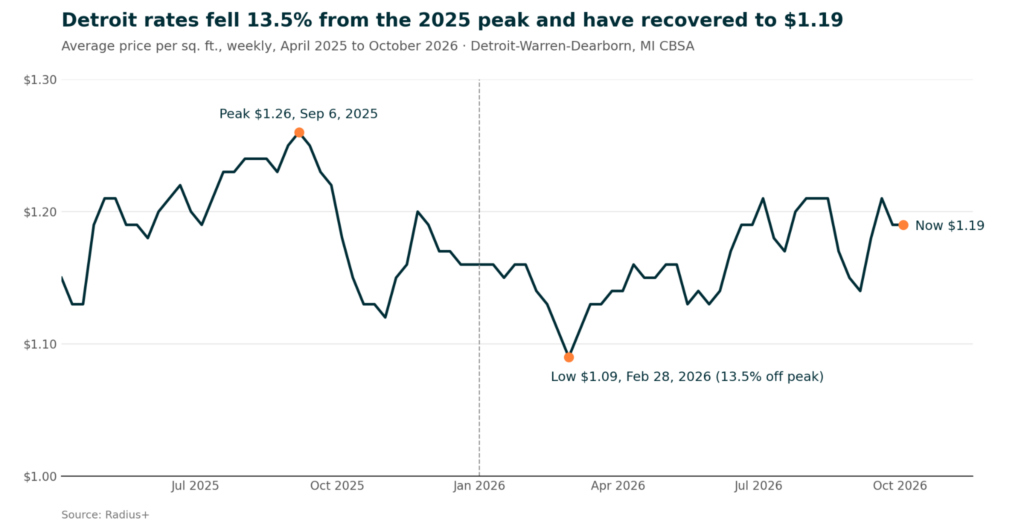
Rates climbed through the 2025 leasing season, then fell hard as the record wave of new facilities opened. By late February they had dropped 13.5% from the September peak.
Since then the market has clawed back most of that loss. Rates today are roughly where they were a year ago. This summer’s high came in below last summer’s, a sign the new supply is still being absorbed.
What Comes Next
The near-term pipeline is thin. Only four projects are under construction, equal to 0.5% of existing supply. The top 100 median is 1.1%.
Further out is a different story. Planned and permitted projects add up to 4.9% of existing supply across 25 projects, slightly above the top 100 median of 4.5%. Add 14 expansions and the full pipeline would grow Detroit’s supply by 7.3%. Not all of it will get built, but it is worth watching.
Demand is tied to the auto industry, which is recalibrating. The University of Michigan’s Detroit economic forecast estimates the city shed about 1,300 blue-collar jobs in late 2025 as GM’s Factory Zero cut to one shift. The same forecast expects that sector to return to growth by the end of 2026. Automakers are shifting production from EVs back toward gas engines, and that adjustment is still playing out.
There are bright spots. In a September 29 speech in Detroit, a Federal Reserve governor noted the city has averaged about 6,000 new businesses a year since the pandemic, adding roughly 30,000 jobs a year.
The setup for operators: with little under construction, the 2025 wave should keep getting absorbed into 2027. If demand holds, rates have room to firm. The planning pipeline will decide how long that window stays open.